 Smita
Smita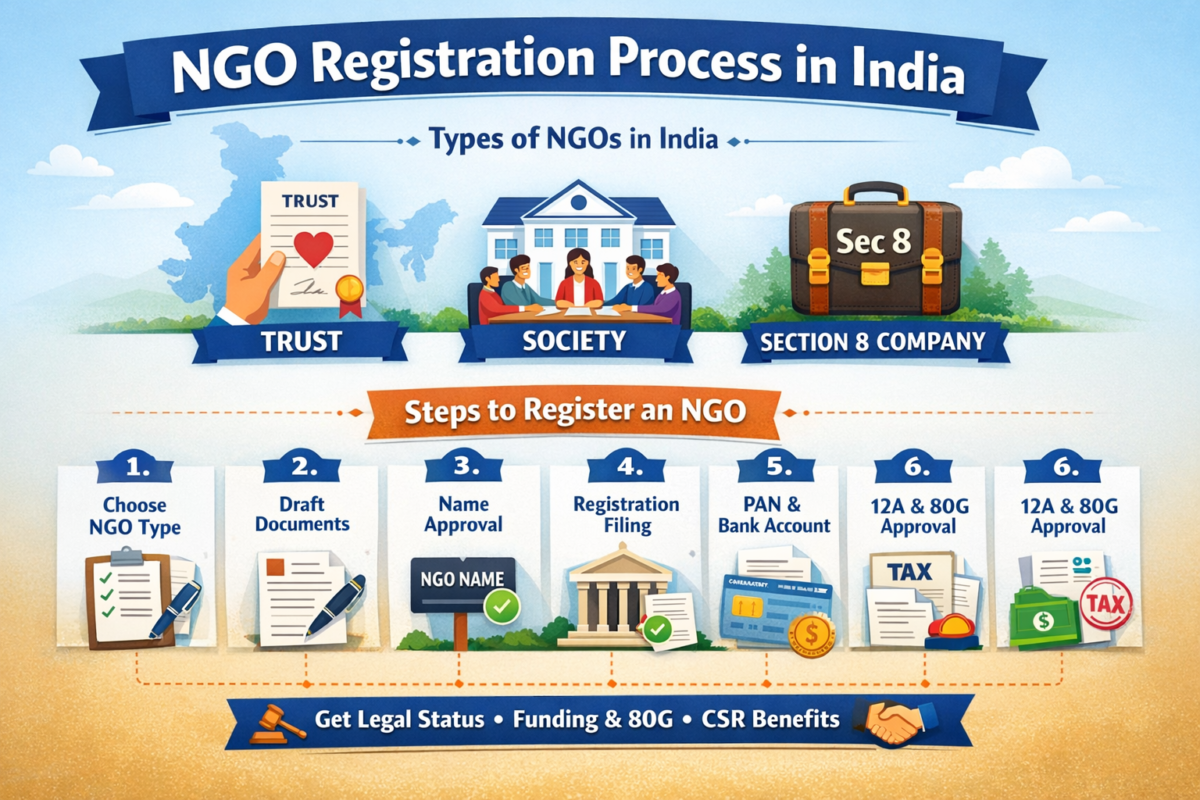
NGO Registration Process in India (2026 Complete Guide)
Starting an NGO Registration Process in India – it’s the first step of your social mission. Whether you want to work in education, women empowerment, health, environment, or rural development, registering your NGO properly will help you get funding, CSR support, government recognition, and public trust.
This 2026 guide explains the NGO registration process in India in simple, practical language – no legal jargon, no confusion. Let’s walk step by step.
Types of NGO in India
In India, there is no single “NGO Act.” NGOs are registered under different laws. You can choose any one of these 3 structures:
Trust
Best for: Small teams, religious or charitable work
Law: Indian Trusts Act, 1882 (varies by state)
Minimum members: 2 trustees
Pros:
Simple registration
Low compliance
Faster to start
Cons:
Limited governance structure
Not ideal for large national NGOs
Society
Best for: Educational, cultural, social organizations
Law: Societies Registration Act, 1860
Minimum members: 7 members
Pros:
Democratic structure
Suitable for state-level and national NGOs
Better credibility than Trust
Cons:
More documentation
Annual compliance required
Section 8 Company
Best for: Professional NGOs, CSR projects, large funding
Law: Companies Act, 2013
Minimum members: 2 directors
Pros:
Highest credibility
Preferred by CSR donors & corporates
Transparent governance
Cons:
Higher compliance
More paperwork & cost
Tip (2026 Reality):
If you are serious about CSR funds and large donors, Section 8 is the best structure.
For small local social work, Trust or Society is enough.
Trust Registration Process
Trust registration is the simplest way to start an NGO in India.
Step-by-Step Trust Registration:
Select Trustees
Minimum 2 trustees. Choose people you trust for long-term work.
Choose Trust Name
Make sure it is unique and not similar to any existing NGO.
Draft Trust Deed
This is the main legal document. It includes:
Name & address of trust
Objectives (education, women, health, etc.)
Trustee details
Rules for management
Prepare Documents
Aadhaar & PAN of trustees
Address proof
Office address proof
Visit Sub-Registrar Office
Trust deed is registered on stamp paper (value depends on state).
Apply for PAN & Bank Account
After registration, open a bank account in trust name.
Timeline: 7–15 working days
Cost (approx): ₹3,000 – ₹10,000 (varies by state)
Society Registration Process
Society registration is ideal for education NGOs, cultural groups, and associations.
Step-by-Step Society Registration:
Minimum 7 Members
President, Secretary, Treasurer + other members.
Choose Society Name
Must be unique and not identical to any registered society.
Draft MOA & Rules
Memorandum of Association (objectives)
Rules & Regulations (management structure)
Prepare Documents
ID proof of members
Address proof
Office address proof
NOC from landlord (if rented office)
Submit to Registrar of Societies
Submit physical or online (depends on state).
Receive Registration Certificate
Timeline: 15–30 days
Cost: ₹5,000 – ₹15,000
Section 8 Company Registration
Section 8 Company is for serious NGOs aiming for CSR funding and large grants.
Step-by-Step Section 8 Process:
Get Digital Signature (DSC)
For directors.
Apply for DIN
Director Identification Number.
Name Approval (RUN service)
Submit name to MCA portal.
Draft MOA & AOA
Mention non-profit objectives clearly.
Apply for License (Section 8)
MCA approval required.
Incorporation Certificate Issued
Timeline: 20–30 days
Cost: ₹10,000 – ₹25,000 (professional fees extra)
Cost & Timeline (Quick Comparison Table)
| NGO Type | Time Required | Approx Cost | Best For |
|---|---|---|---|
| Trust | 7–15 days | ₹3k–₹10k | Small NGOs |
| Society | 15–30 days | ₹5k–₹15k | State/National NGOs |
| Section 8 | 20–30 days | ₹10k–₹25k | CSR, large funding |
Common Mistakes (Avoid These in 2026)
Choosing wrong NGO structure
Copy-paste objectives (leads to rejection)
No clear mission or area of work
Wrong or duplicate NGO name
Not applying for 12A & 80G after registration
No digital presence (website, email, WhatsApp)
Ignoring annual compliance
Reality Check:
Many NGOs fail not because of funding, but because they don’t complete compliance properly.
FAQs in NGO Registration Process in India
Can one person start an NGO in India?
No. Minimum 2 people (Trust / Section 8) and 7 for Society.
Is NGO registration free in India?
No. There are government stamp duties and professional charges.
Can I register NGO from home address?
Yes. You can use your home address as office address.
Is GST required for NGO?
Only if your NGO provides taxable services or crosses GST limit.
How to get funding after registration?
You should apply for:
12A & 80G
CSR-1 Registration
NGO Darpan
Build website & donor profile
Final Advice (2026)
If you want to work seriously with CSR companies, ministries, or international donors, don’t rush.
Choose the right structure, right objectives, and complete legal compliance from day one.
Tilak Varma Biography: Age, Family, Career, IPL Starts, Net Worth and More
Tilak Varma Biography: Age, Family, Career, IPL Starts, Net Worth and More